Yes, EU and Schengen citizens can get an Iran visa in 2026 – and the process is relatively straightforward compared to US or UK passport holders. Most European nationals can apply online through Iran’s e-Visa system, obtain a visa on arrival at major airports, or apply at an Iranian embassy. Processing typically takes 1-3 weeks, and costs range from €40 to €120 depending on nationality and visa type.
This guide covers every aspect of the Iran visa process for EU and Schengen Area citizens – from eligibility and application methods to fees, processing times, and country-specific requirements across all 27 EU member states plus Switzerland, Norway, Iceland, and Liechtenstein.
Can EU Citizens Visit Iran in 2026?
Yes, citizens of all 27 EU member states and the 4 Schengen non-EU countries (Switzerland, Norway, Iceland, Liechtenstein) can visit Iran with a valid visa. European passport holders benefit from one of the most favorable visa processes among Western nationalities.
Key advantages for EU/Schengen citizens:
- e-Visa eligible – Most European nationals can apply through the Iran e-Visa portal at evisa.mfa.ir
- Visa on arrival available – EU citizens can obtain a VOA at Tehran Imam Khomeini, Isfahan, Shiraz, Tabriz, Mashhad, and other international airports
- No mandatory guided tour – Unlike US, UK, and Canadian citizens, EU passport holders can travel independently
- Standard processing time – Expect 5-15 business days for e-Visa approval
- Multiple entry options – Tourist visas can be issued as single or multiple entry
Important exception: British passport holders (post-Brexit) face stricter requirements similar to US citizens, including a mandatory guided tour since October 2025. UK nationals should refer to separate guidance.
Which EU Countries Have Easiest Access?
While all EU/Schengen citizens face similar visa requirements, processing times and approval rates vary by nationality:
| Nationality Group | e-Visa | VOA | Processing Time | Notes |
|---|---|---|---|---|
| Germany, France, Italy, Spain | Yes | Yes | 5-10 days | Highest approval rates |
| Netherlands, Belgium, Austria | Yes | Yes | 5-12 days | Very straightforward |
| Poland, Czech Republic, Hungary | Yes | Yes | 7-14 days | Slightly longer processing |
| Greece, Portugal, Ireland | Yes | Yes | 7-14 days | Standard process |
| Scandinavian countries (SE, DK, FI, NO) | Yes | Yes | 5-12 days | Clean approval history |
| Switzerland, Liechtenstein | Yes | Yes | 5-10 days | Non-EU Schengen equally eligible |
| Iceland, Norway | Yes | Yes | 7-12 days | Schengen members, full access |
| Baltic states (EE, LV, LT) | Yes | Yes | 7-14 days | Standard processing |
German and French nationals consistently report the smoothest application experiences, with the highest approval rates and fastest processing among all European countries.
Iran Visa Requirements for EU Citizens
To apply for an Iran tourist visa as an EU or Schengen citizen, prepare the following documents:
| Requirement | Details |
|---|---|
| Valid passport | Must be valid for at least 6 months beyond your travel dates |
| Passport photo | Recent digital photo (white background, no glasses) |
| Completed application form | Via e-Visa portal or embassy |
| Travel itinerary | Recommended but not always mandatory for e-Visa |
| Travel insurance | Must cover Iran; available at airport for €10-15 if needed |
| Accommodation proof | Hotel booking confirmation for at least the first night |
| Return flight | Proof of onward travel (can be flexible dates) |
No invitation letter is required for EU citizens applying for a tourist visa. This is a significant advantage over nationalities that need a Letter of Invitation (LOI) from an Iranian sponsor.
Passport Restrictions
Your passport must NOT contain:
- An Israeli visa or entry/exit stamp dated within the last 365 days
- A stamp from any Israeli border crossing (Allenby, Taba, Jordan River, Arava)
- No pages for stamps – your passport must have at least 2 blank pages
If your passport has an old Israeli stamp (older than 365 days), entry is theoretically possible but border officials may still refuse. The safest approach is to carry a second passport if your country issues them, or renew your passport before traveling.
How to Apply for an Iran Visa: Three Methods
EU citizens have three application pathways. Choose based on your timeline and preferences.
Method 1: Iran e-Visa (Recommended)
The Iran e-Visa system is the most convenient option for EU citizens.
Step 1 – Visit evisa.mfa.ir and create an account.
Step 2 – Select your nationality, visa type (Tourist – Type B), and duration (30 days standard).
Step 3 – Upload your passport scan and digital photo.
Step 4 – Fill in travel details including intended arrival date and accommodation.
Step 5 – Submit and wait for approval (5-15 business days).
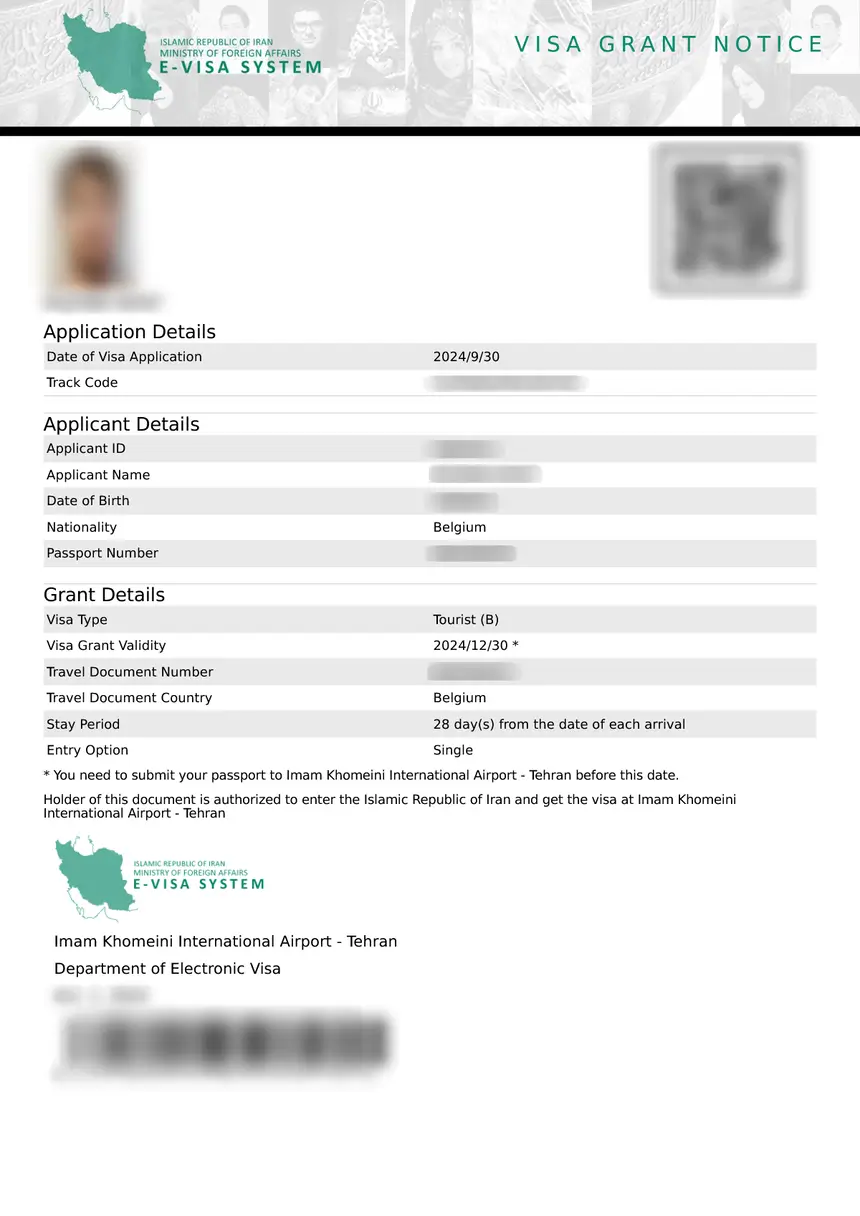
Step 6 – Download your visa authorization code from the portal.
Step 7 – Present the authorization code at the Iranian airport immigration counter upon arrival to receive your visa sticker.
Method 2: Visa on Arrival
EU citizens can obtain a visa on arrival at major Iranian international airports. This is convenient but carries a small risk of refusal at the airport.
Where to get VOA:
- Tehran Imam Khomeini International Airport (IKA) – most reliable
- Isfahan International Airport (IFN)
- Shiraz International Airport (SYZ)
- Tabriz International Airport (TBZ)
- Mashhad International Airport (MHD)
VOA process at the airport:
- Proceed to the dedicated visa counter before passport control
- Present your passport, passport photo, and travel insurance proof
- Pay the visa fee in cash (EUR or USD)
- Wait 30-60 minutes for processing
- Receive your visa sticker and proceed through immigration
Method 3: Embassy Application
Apply at an Iranian embassy or consulate in your EU country for the most traditional approach.
Advantages of embassy application:
- Visa is pre-stamped in your passport before departure
- No risk of airport refusal
- Can apply for longer durations (up to 90 days)
- Can request multiple entry visas
Where to apply: Iranian embassies exist in Berlin, Paris, Rome, The Hague, Brussels, Vienna, Madrid, Stockholm, and most other EU capitals. Check your country’s specific embassy for appointment requirements.
Iran Visa Fees for EU Citizens
The Iran visa fee depends on your nationality and application method:
| Nationality | e-Visa Fee | VOA Fee | Embassy Fee |
|---|---|---|---|
| German | €40-60 | €50-75 | €50-80 |
| French | €40-60 | €50-75 | €50-80 |
| Italian | €40-60 | €50-75 | €50-80 |
| Spanish | €40-60 | €50-75 | €50-80 |
| Dutch | €40-60 | €50-75 | €50-80 |
| Polish | €40-60 | €50-75 | €50-80 |
| Swedish | €40-60 | €50-75 | €50-80 |
| Austrian | €40-60 | €50-75 | €50-80 |
| Swiss | €40-60 | €50-75 | €50-80 |
| Other EU | €40-75 | €50-80 | €50-90 |
Additional costs to budget:
- Travel insurance: €10-15 (mandatory, must cover Iran specifically)
- Agency fees (optional): €30-80 if using a visa agency for processing
- Express processing: Some embassies offer faster processing for an additional €20-40
Fees are payable in EUR or USD. VOA fees at airports must be paid in cash – ATMs in Iranian airports do not dispense foreign currency, and international cards do not work in Iran due to banking sanctions.
Iran Visa Processing Time for EU Citizens
Processing times vary by application method:
| Method | Typical Duration | Best For |
|---|---|---|
| e-Visa | 5-15 business days | Most EU travelers |
| Visa on Arrival | 30-60 minutes at airport | Last-minute trips |
| Embassy | 7-21 business days | Longer/multiple entry visas |
Factors that affect processing time:
- Nationality – German, French, and Italian passports process fastest
- Season – Nowruz (late March) and summer months have higher volumes
- Completeness – Incomplete applications cause delays of 1-2 weeks
- Security checks – Some nationalities trigger additional review
Recommendation: Apply at least 4 weeks before your intended travel date. This provides buffer for any delays without affecting your trip plans.
Duration of Stay and Visa Validity
Standard Iran tourist visas for EU citizens:
- Duration: 30 days (most common)
- Validity: 90 days from issuance (enter within this window)
- Entries: Single entry (default) or multiple entry (upon request)
- Extension: Extendable once at immigration offices in Tehran, Isfahan, Shiraz, Tabriz, or Mashhad for an additional 30 days
Longer stays: EU citizens can request 60-day or 90-day visas through embassy applications. This requires more documentation and longer processing times, but is granted regularly for German, French, and Italian nationals.
Travel Insurance for Iran
Travel insurance is mandatory for all EU citizens entering Iran. The insurance must explicitly cover Iran – many European travel insurance policies exclude Iran due to sanctions.
Options for obtaining insurance:
- At the airport – Available at VOA counters for €10-15 for 30 days
- Iranian insurance companies – Purchase online before arrival through your travel agency
- Specialized providers – Some European insurers offer Iran-specific coverage (e.g., IATI, Battleface)
What your insurance must cover:
- Medical treatment in Iran
- Emergency evacuation
- Minimum coverage of €30,000 (recommended)
- The exact dates of your stay
Important Rules for EU Citizens in Iran
Once in Iran, EU citizens must follow these regulations:
- Registration – Hotels register your passport automatically. If staying with locals, register at the local police station within 24 hours.
- Dress code – Women must wear a headscarf and cover arms and legs in public. Men should avoid shorts in public spaces.
- Photography – Military installations, government buildings, and some bridges are off-limits for photography.
- Alcohol – Alcohol is strictly prohibited throughout Iran.
- Drone use – Drones require special permits from Iranian authorities. Flying without permission can result in confiscation and detention.
- Currency – International bank cards do not work in Iran. Bring sufficient EUR or USD cash for your entire stay.
EU Citizens with Dual Nationality
Special rules apply if you hold EU and another nationality:
EU + Iranian dual nationals: Iran considers you an Iranian citizen. You must enter on an Iranian passport and may be subject to military service requirements if you are male and under a certain age.
EU + other dual nationals: Enter on your EU passport. The second nationality generally does not affect your visa application unless it is Israeli.
Frequently Asked Questions
Do EU citizens need a visa for Iran?
Yes, all EU and Schengen citizens need a visa to enter Iran. However, the process is straightforward – most can apply online via the e-Visa system or obtain a visa on arrival at Iranian airports.
Can EU citizens get an Iran visa on arrival?
Yes, citizens of all 27 EU countries plus Switzerland, Norway, Iceland, and Liechtenstein can obtain a visa on arrival at Tehran Imam Khomeini Airport and several other international airports in Iran. The process takes 30-60 minutes at the airport.
How much does an Iran visa cost for EU citizens?
The Iran visa costs between €40 and €90 for EU citizens depending on nationality and application method. e-Visa is generally cheapest at €40-60, while embassy applications may cost €50-90. Add €10-15 for mandatory travel insurance.
How long does it take to get an Iran visa for EU citizens?
e-Visa processing takes 5-15 business days. Visa on arrival is processed in 30-60 minutes at the airport. Embassy applications take 7-21 business days. Apply at least 4 weeks before travel for a buffer.
Can German citizens travel to Iran independently?
Yes, German citizens can travel independently in Iran without a mandatory guided tour. This is a significant advantage over US, UK, and Canadian passport holders who must book guided tours. German nationals benefit from fast processing and high approval rates.
Do French citizens need an invitation letter for Iran?
No, French citizens applying for an Iran tourist visa do not need an invitation letter or Letter of Invitation (LOI). The e-Visa and VOA processes only require a valid passport, photo, and travel insurance.
Can I visit Iran with an Israeli stamp in my EU passport?
If the Israeli stamp is older than 365 days, entry is theoretically allowed but risky. If the stamp is newer than 365 days, you will be denied entry. The safest option is to renew your passport or carry a second passport if your EU country allows it.
Is it safe for EU citizens to travel to Iran?
Most EU citizens report positive experiences traveling in Iran. However, several European governments advise increased caution. Check your country’s travel advisory before planning your trip. EU citizens should register with their embassy upon arrival.
Can I use my credit card in Iran?
No, international credit and debit cards do not work in Iran due to banking sanctions. Bring sufficient EUR or USD cash for your entire trip. You can exchange money at official exchange offices (sarafi) in major cities.
Can EU citizens extend their Iran visa?
Yes, EU citizens can extend their tourist visa once for an additional 30 days at immigration offices (Gozar-e Nameh) in Tehran, Isfahan, Shiraz, Tabriz, or Mashhad. Apply before your current visa expires. Extensions cost approximately €20-30.