Iran issues eleven distinct visa categories, each designed for a specific travel purpose – from tourism and pilgrimage to business, medical treatment, and transit. Understanding which type fits your trip is the first step toward a smooth application. This guide breaks down every Iran visa type, who qualifies, and what documents you need.
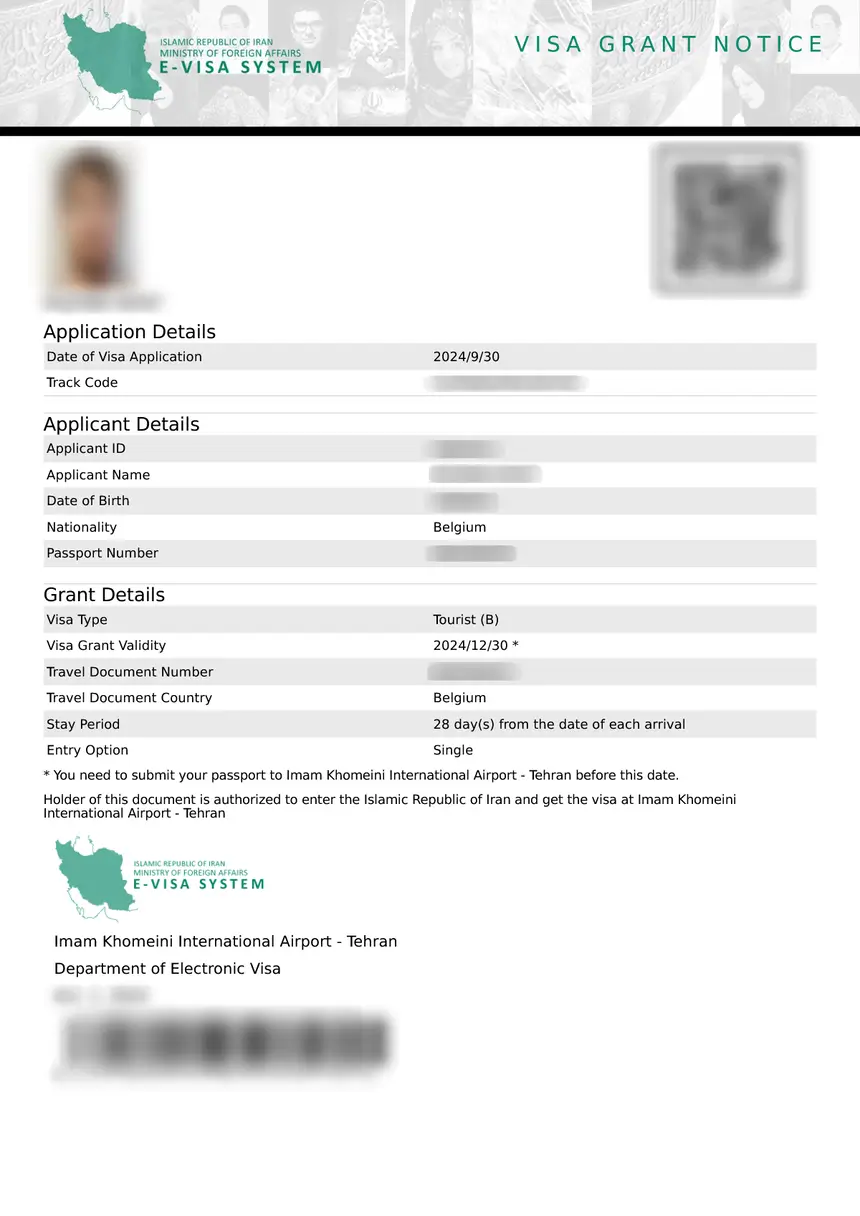
Overview of Iran Visa Categories
The Iranian Ministry of Foreign Affairs (MFA) classifies non-immigrant visas using letter codes. Each code corresponds to a specific purpose of travel. The table below summarizes all eleven categories at a glance.
| Code | Visa Type | Purpose | Typical Duration |
|---|---|---|---|
| A | Entry | Business negotiations, official meetings | 30 days (extendable) |
| B | Tourist | Sightseeing, cultural travel | 30 days (extendable to 90) |
| C | Pilgrimage (Ziarat) | Visiting holy shrines | 30 days (extendable) |
| D / S | Diplomatic / Service | Official government travel | Varies |
| E | Education | University study, religious seminary | Duration of program |
| F | Temporary Work | Employment in Iran | Duration of contract |
| G | Transit | Passing through Iran | 7 days |
| H | Media | Journalism, film production | Per assignment |
| I | Investment | Approved foreign investment | Varies |
| M | Marital | Spouses of Iranian citizens | Long-term |
| T | Medical | Healthcare treatment | Per treatment plan |
You can apply for most of these categories through the Iran e-Visa portal operated by the MFA.
Tourist Visa (Type B)
The Tourist Visa is by far the most common type for leisure travelers. It allows foreign nationals to visit Iran for sightseeing, cultural exploration, and visiting friends or relatives.
- Eligibility: All nationalities (some require prior approval)
- Duration: Up to 30 days, extendable twice for a total of 90 days
- How to apply: Online via the MFA e-Visa system or at an Iranian embassy/consulate
- Documents needed: Completed visa application, valid passport, passport-size photo, travel insurance
Tourist visa fees typically range from EUR 40 to EUR 75 depending on your nationality. For a deeper look, see our Iran Tourist Visa guide.
Entry Visa (Type A)
The Entry Visa (also called the Business Entry Visa) is for foreign nationals who have a formal invitation from an Iranian government ministry, public organization, or registered private company. It covers activities such as:
- Negotiating contracts
- Setting up or servicing purchased machinery
- Attending business meetings and conferences
- Consulting with Iranian partners
Key requirement: A valid invitation letter from the inviting organization in Iran, approved through the MFA system. Without this letter, you cannot apply for an Entry Visa.
For general business travel without an official invitation, some travelers use the Tourist Visa instead. If you need guidance on business-specific requirements, see our Iran Business Visa guide.
Pilgrimage Visa (Type C)
The Pilgrimage Visa, known locally as the Ziarat Visa, is specifically for Muslim travelers who wish to visit Iran’s holy shrines and religious sites. Major pilgrimage destinations include:
- Imam Reza Shrine in Mashhad
- Hazrat Masoumeh Shrine in Qom
- Shah Cheragh Shrine in Shiraz
This visa is available only to Muslim applicants. The application process is similar to the Tourist Visa, but you must indicate your pilgrimage purpose. Fees for pilgrimage visas are generally lower – around EUR 20 for Lebanese citizens, for example.
For the full application process, see our Iran Pilgrimage Visa guide.
Diplomatic and Service Visa (Types D and S)
These two categories serve official and government travelers:
- Diplomatic Visa (Type D): For holders of diplomatic passports attending conferences, cultural programs, or serving at diplomatic missions in Iran.
- Service Visa (Type S): For holders of official (service) passports traveling on government business.
Both types require the passport holder to have the appropriate diplomatic or official passport. Applications are typically processed through government channels rather than the standard e-Visa portal.
Education Visa (Type E)
The Education Visa is for foreign students and religious scholars enrolled at Iranian universities, colleges, or seminaries. To qualify, you need:
- A Certificate of Eligibility from Iran’s Ministry of Science, Ministry of Education, or an accredited academic institution
- Proof of enrollment or admission letter
- Valid passport and photos
The visa duration aligns with the academic program. Students can apply for extensions as needed.
Temporary Work Visa (Type F)
The Temporary Work Visa allows skilled foreign workers, specialists, and engineers to work in Iran legally. The requirements include:
- A labor certificate from a sponsoring employer in Iran, approved by the Ministry of Labor
- Proof of professional qualifications
- Valid employment contract
This visa is not available through the standard e-Visa portal and requires employer sponsorship.
Transit Visa (Type G)
The Transit Visa lets travelers pass through Iran without intending to stay. It is commonly used by:
- Truck drivers and commercial transporters
- Tourists traveling overland between neighboring countries
- Merchants transiting to a third country
Duration: Up to 7 days, with no extension possible. You must show a valid visa for your destination country (if required) and declare your transit route.
For detailed information, see our Iran Transit Visa guide.
Media Visa (Type H)
Journalists, reporters, film producers, and cameramen traveling to Iran for professional media work must obtain a Media Visa. This requires:
- A permit from Iran’s Media and Public Diplomacy Center
- A completed visa application
- Details of the media assignment
Freelance journalists and documentary filmmakers also fall under this category. Tourist visas are not valid for media work in Iran.
Investment Visa (Type I)
The Investment Visa is for foreign nationals whose investment has been approved by the Organization for Investment, Economic and Technical Assistance of Iran (OIETAI). This visa supports:
- Foreign direct investment in Iranian businesses
- Joint ventures with Iranian companies
- Approved development projects
Applicants must present an approval letter from OIETAI along with their visa application.
Marital Visa (Type M)
The Marital Visa is designed for foreign men married to Iranian women, as well as their children. Key points:
- If the marriage is not yet registered in the Iranian legal system, the foreign spouse may apply for an Entry Visa (Relatives) instead
- Children of such families also qualify under this category
- A father’s official permission is required for children’s travel to Iran
Medical Visa (Type T)
Iran has become a popular destination for medical tourism, and the Medical Visa supports this growing sector. To apply, you need:
- An approval letter from one of Iran’s authorized medical centers
- A completed visa application
- Medical records related to your treatment
For more details on healthcare travel, see our Iran Medical Visa guide.
How to Choose the Right Iran Visa Type
Follow this decision guide to identify the correct visa for your trip:
- Traveling for leisure or sightseeing? – Apply for the Tourist Visa (Type B)
- Have an official invitation from an Iranian organization? – Apply for the Entry Visa (Type A)
- Visiting holy sites as a Muslim pilgrim? – Apply for the Pilgrimage Visa (Type C)
- Passing through Iran to another country? – Apply for the Transit Visa (Type G)
- Seeking medical treatment? – Apply for the Medical Visa (Type T)
- Studying at an Iranian institution? – Apply for the Education Visa (Type E)
- Working for an Iranian employer? – Apply for the Temporary Work Visa (Type F)
- Traveling on government or diplomatic business? – Apply for Diplomatic (D) or Service (S) Visa
Visa on Arrival vs. e-Visa
In addition to embassy applications, Iran offers two streamlined options for many nationalities:
- Visa on Arrival (VOA): Available at major international airports (Tehran Imam Khomeini, Isfahan, Shiraz, Tabriz, Mashhad) for citizens of most countries. Not available for US, UK, Canada, Afghanistan, Bangladesh, Colombia, Jordan, Pakistan, and Somalia passport holders.
- e-Visa: Apply online through the MFA portal before traveling. The e-Visa approval allows you to collect your visa on arrival or at an embassy. Processing typically takes up to 10 business days.
For a detailed comparison, see our eVisa vs Visa on Arrival guide.
Iran Visa Fees by Type
| Visa Type | Approximate Fee (EUR) | Notes |
|---|---|---|
| Tourist (B) | 40 – 75 | Varies by nationality |
| Entry (A) | 40 – 100 | Invitation letter required |
| Pilgrimage (C) | 10 – 40 | Lower fees for some nationalities |
| Transit (G) | 30 – 50 | 7-day limit |
| Medical (T) | 40 – 80 | Medical center approval required |
| Visa on Arrival | 30 – 50 | Airport only, not all nationalities |
Fees are approximate and change based on bilateral agreements and nationality. Travel insurance (EUR 10 – 15) is mandatory for all visa types. For a complete fee breakdown, see our Iran Visa Fee guide.
Frequently Asked Questions
Can US citizens get an Iran visa?
US citizens can apply for an Iran visa, but the process requires more steps. They cannot use the Visa on Arrival option and must apply through the Pakistani embassy in Washington (which handles Iran’s consular interests in the US) or through a third-country embassy. Processing times are longer, and guided tours may be mandatory.
What is the most common Iran visa type for tourists?
The Tourist Visa (Type B) is the most common choice for leisure travelers. It allows stays of up to 30 days, extendable to 90 days, and can be obtained via the e-Visa portal, at an embassy, or on arrival at major airports.
Can I change my visa type while in Iran?
Generally, you cannot change your visa type while inside Iran. If you entered on a Tourist Visa and need to work or study, you must leave Iran and apply for the correct visa type from abroad.
How long does it take to process an Iran visa?
Standard processing through the e-Visa portal takes up to 10 business days. Embassy applications may take 1 – 4 weeks depending on the embassy and your nationality. Visa on Arrival is issued at the airport but requires e-Visa pre-approval for some nationalities.
Is Iran visa-free for any countries?
Yes. Citizens of Armenia, Oman, Syria, Turkey, Georgia, Iraq, Tajikistan, China, Hong Kong, Macao, Egypt, and Venezuela can enter Iran without a visa for stays ranging from 14 to 90 days. Citizens of about 30 additional countries get 15-day visa-free entry for tourism.
Do I need travel insurance for an Iran visa?
Yes. Travel insurance is mandatory for all Iran visa types. The cost is typically EUR 10 – 15 and must cover your entire stay. Some policies purchased abroad are accepted, but you can also buy insurance at the airport on arrival.
What is the difference between Entry Visa and Tourist Visa?
The Entry Visa (Type A) requires an official invitation letter from an Iranian organization and is for business, professional, or official purposes. The Tourist Visa (Type B) does not require an invitation and is for leisure travel. If you are visiting Iran for sightseeing and have no formal invitation, the Tourist Visa is the correct choice.
Next Steps
Now that you know which Iran visa type fits your trip:
- Ready to apply? Start with our Iran e-Visa application guide
- Need the full application walkthrough? See our step-by-step Iran visa application
- Checking document requirements? Read our Iran visa requirements checklist
- Comparing costs? View the complete Iran visa fee breakdown