Pakistani passport holders can travel to Iran through multiple visa pathways, including an e-Visa application, visa on arrival at Iranian airports, or a traditional embassy/consulate visa. Iran offers accessible visa options for Pakistani citizens, with tourist visas valid for up to 30 days and extendable up to 90 days. This guide covers every requirement, fee, and step you need to know before your trip.
Do Pakistani Citizens Need a Visa for Iran?
Yes, Pakistani citizens need a visa to enter Iran. The good news is that the process is relatively straightforward compared to many other destinations. Pakistan is not on Iran’s list of restricted nationalities, which means Pakistani passport holders can apply through all standard channels:
- e-Visa (online pre-approval through the MFA portal)
- Visa on Arrival (VOA) at major Iranian international airports
- Embassy/consulate visa obtained in advance
Pakistan and Iran share a long land border and have strong cultural and religious ties, which generally makes the visa process smoother for Pakistani applicants. However, it is always recommended to verify your specific eligibility through the official MFA e-Visa portal before traveling.
For the most current fee structure by nationality, see our Iran visa fee guide.
Iran Visa Types Available to Pakistani Citizens
Pakistani passport holders can apply for several categories of Iran visa depending on the purpose of their visit:
| Visa Type | Purpose | Duration | Extendable |
|---|---|---|---|
| Tourist Visa | Sightseeing, cultural visits | Up to 30 days | Yes (2x 30 days) |
| Pilgrimage Visa (Ziarat) | Religious sites in Mashad, Qom | Up to 30 days | Yes |
| Business Visa | Meetings, conferences, trade | Up to 30 days | Yes |
| Transit Visa | Passing through Iran | Up to 7 days | No |
| Medical Visa | Healthcare treatment | As needed | Yes |
The pilgrimage visa is particularly popular among Pakistani travelers, as millions visit the holy shrines in Mashhad and Qom each year. The tourist visa is the most common choice for general travel. Both allow single or multiple entry and can be obtained through the e-Visa system, on arrival, or at an Iranian embassy.
For a complete overview of all visa categories, visit our Iran visa types guide.
How to Apply for an Iran e-Visa from Pakistan
The e-Visa system is the most convenient option for Pakistani citizens. Here is the step-by-step process:
Step 1: Complete the Online Application
Visit the official MFA e-Visa portal at evisa.mfa.ir and fill out the application form. You will need to provide:
- Full name (as it appears on your passport)
- Passport number and expiry date (must be valid for at least 6 months)
- Nationality and date of birth
- Intended entry and exit dates
- Accommodation details in Iran
- A recent passport-size photograph (digital upload)
Step 2: Submit Required Documents
Upload the following documents along with your application:
- Scanned copy of your passport’s information page
- Passport-size photo (white background, recent)
- Travel itinerary or hotel booking confirmation
- Travel insurance covering Iran (mandatory)
Step 3: Wait for Processing
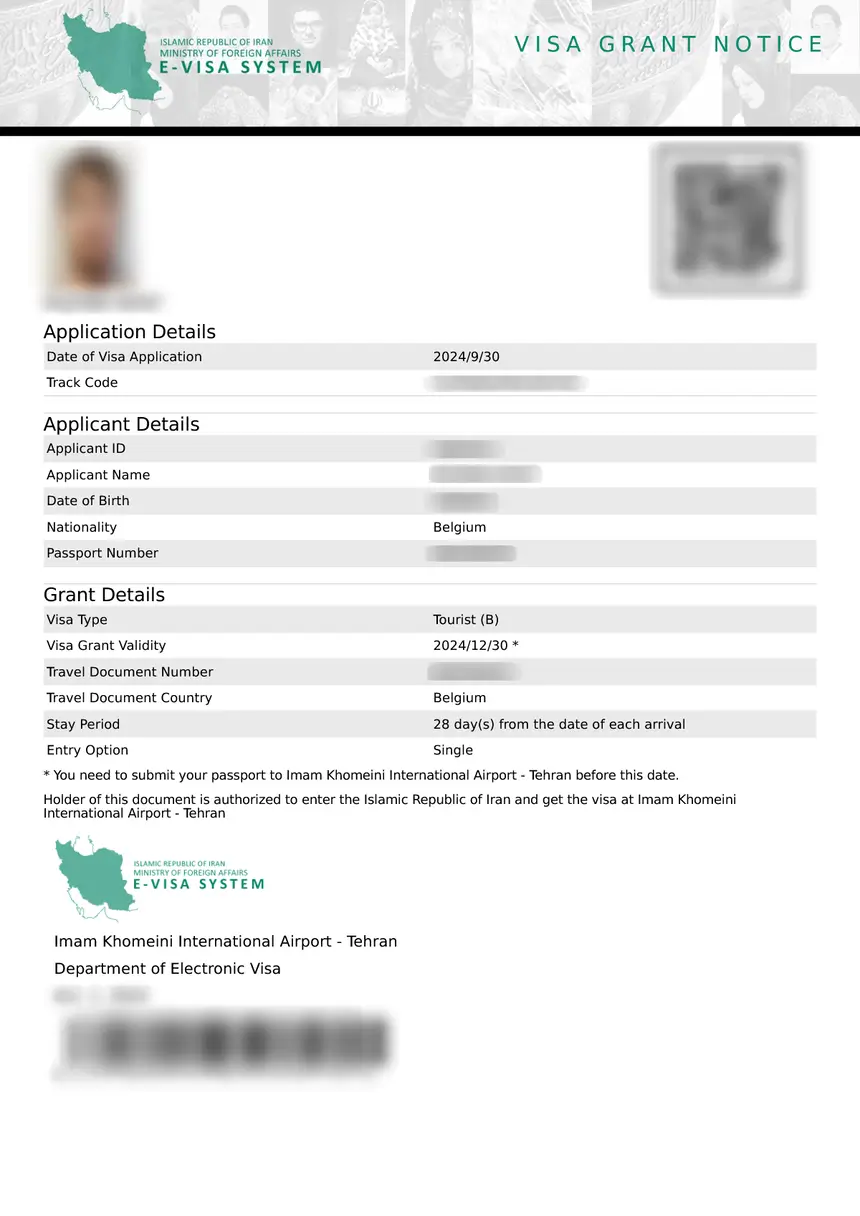
Standard processing takes 5 to 15 business days for Pakistani citizens. During peak travel seasons – particularly around Muharram, Arbaeen, and Nowruz (March) – processing times may be longer. You will receive a Visa Authorization Code by email once approved.
Step 4: Collect Your Visa
With the Visa Authorization Code, you can:
- Collect your visa at the Iranian Embassy in Islamabad or the Consulate General in Karachi, Lahore, Quetta, or Peshawar
- Pick it up on arrival at major Iranian airports (Imam Khomeini International Airport in Tehran is the primary entry point)
For a detailed walkthrough of the entire application process, see our Iran visa application guide.
Iran Visa on Arrival for Pakistani Citizens
Pakistani passport holders are eligible for a Visa on Arrival (VOA) at Iran’s international airports. This is a popular option for pilgrims and travelers who want to avoid embassy visits.
Where to Get VOA
VOA is available at the following airports:
- Imam Khomeini International Airport (IKA) – Tehran (primary hub)
- Mashhad International Airport – for pilgrimage travelers
- Shiraz International Airport
- Isfahan International Airport
- Tabriz International Airport
VOA Requirements for Pakistani Citizens
To obtain a VOA, you must have:
- A passport valid for at least 6 months beyond your entry date
- A completed arrival form (provided on the plane or at the airport)
- Two passport-size photographs
- Proof of accommodation (hotel booking or host invitation)
- Travel insurance valid in Iran (can be purchased at the airport if needed)
- Sufficient funds for your stay
- A return or onward flight ticket
VOA Processing Time at the Airport
Expect to wait 30 minutes to 2 hours at the VOA counter. During busy periods (Muharram, Arbaeen, peak tourist season), wait times can be longer. The visa is typically issued for 30 days.
Important: While VOA is available, applying for an e-Visa in advance is strongly recommended for Pakistani citizens. Having a pre-approved authorization code speeds up the airport process and reduces the risk of unexpected delays or denials.
Iran Visa Fees for Pakistani Citizens
The cost of an Iran visa for Pakistani citizens depends on the type and method of application:
| Visa Type | Fee (EUR) | Notes |
|---|---|---|
| Tourist Visa (embassy) | 40-80 | Varies by processing time |
| Visa on Arrival (VOA) | 30-50 | Paid at airport in EUR |
| e-Visa processing | Included in visa fee | No separate application fee |
| Travel Insurance | 10-15 | Mandatory for all visitors |
Visa fees are payable in Euros (EUR) or the equivalent in Iranian Rial. ATMs at the airport dispense Rial, but it is advisable to carry EUR or USD cash for the visa fee payment.
For the latest fee breakdown and payment methods, check our complete Iran visa fee guide.
Required Documents Checklist
Before applying for your Iran visa, make sure you have all of the following:
- Valid passport with at least 6 months validity and 2 blank pages
- Passport-size photographs (2 copies, white background, recent)
- Completed application form (online for e-Visa, paper for embassy)
- Travel insurance covering Iran (many international policies exclude Iran, so verify in advance)
- Hotel booking confirmation or invitation letter from your host in Iran
- Flight itinerary showing entry and exit dates
- Proof of sufficient funds (bank statement or credit card)
Iran Visa Processing Time from Pakistan
Processing times vary depending on the application method:
| Method | Processing Time | Recommendation |
|---|---|---|
| e-Visa (online) | 5-15 business days | Best for advance planners |
| Embassy (Islamabad) | 7-14 business days | Required for complex cases |
| Consulate (Karachi/Lahore) | 7-14 business days | Alternative to embassy |
| VOA (at airport) | 30 min – 2 hours | Convenient but riskier |
Apply at least 4 weeks before your intended travel date to allow for any delays. During Iranian holidays (Nowruz, Ramadan, Muharram), processing can take significantly longer.
Land Border Crossings: Pakistan to Iran
Pakistan and Iran share several land border crossings, which is a unique advantage for Pakistani travelers. The main crossings are:
- Taftan-Mirjaveh – The most commonly used crossing, connecting Balochistan (Pakistan) with Sistan-Baluchestan (Iran). This is the crossing used by the Quetta-Taftan train.
- Gabd-Rimdan – A newer crossing point in southern Balochistan.
Important Notes for Land Crossings
- You must have a valid visa before arriving at the land border (VOA is only available at airports)
- The Taftan crossing area has security advisories; check current travel warnings before traveling overland
- The Quetta-Taftan train runs periodically but schedules can be unreliable
- Hiring a local guide or using organized transport is recommended for the border region
Special Considerations for Pakistani Travelers
Pilgrimage Travel
Pakistan is one of the largest sources of pilgrimage travelers to Iran. Key points for pilgrims:
- The pilgrimage visa (Ziarat) is specifically designed for visits to holy shrines
- Popular destinations include Mashhad (Imam Reza Shrine) and Qom (Fatima Masumeh Shrine)
- Travel agencies in Pakistan specialize in pilgrimage packages that include visa processing
- Peak pilgrimage periods (Muharram, Ramadan, Arbaeen) see high demand – apply well in advance
Travel Insurance
Iran requires all visitors to have valid travel insurance. Many international insurance providers do not cover Iran due to sanctions. Options include:
- Purchasing insurance at the airport on arrival (available at VOA counters)
- Buying from an Iran-specific travel insurance provider online before departure
- Checking if your existing Pakistani travel insurance covers Iran specifically
Currency and Payments
Due to international sanctions, international credit and debit cards (Visa, Mastercard) do not work in Iran. Pakistani travelers should:
- Carry sufficient EUR or USD cash for the entire trip
- Exchange currency at official exchange shops (not the airport for best rates)
- Budget approximately $25-50 per day for mid-range travel
- Pakistani Rupee can sometimes be exchanged but EUR or USD are preferred
Dress Code
Iran has a mandatory dress code that applies to all visitors:
- Women: Must wear a headscarf (hijab) covering the hair, and loose-fitting clothing covering arms and legs
- Men: No shorts in public; long trousers and sleeved shirts are expected
Language
While Farsi (Persian) is the official language of Iran, Pakistani travelers have some advantages:
- Many Iranians in border regions understand Urdu
- English is spoken in tourist areas and major hotels
- Arabic is useful for religious contexts, especially at shrines
- Having a translation app or phrasebook is recommended
Safety for Pakistani Travelers
Iran is generally considered safe for Pakistani tourists. The two countries share strong diplomatic and cultural relations. However, standard travel precautions apply:
- Keep copies of your passport and visa
- Register with the Pakistani Embassy in Tehran upon arrival
- Avoid photographing military installations or government buildings
- Be cautious in the border regions of Sistan-Baluchestan province
FAQs About Iran Visa for Pakistani Citizens
Can Pakistani citizens get a visa on arrival in Iran?
Yes, Pakistani passport holders can obtain a Visa on Arrival (VOA) at major Iranian international airports, including Tehran Imam Khomeini (IKA), Mashhad, Shiraz, Isfahan, and Tabriz. The VOA is valid for 30 days. However, applying for an e-Visa in advance is strongly recommended to avoid airport delays and potential issues.
How much does an Iran visa cost for Pakistani citizens?
The visa fee ranges from EUR 30-50 for VOA and EUR 40-80 for embassy processing. You will also need mandatory travel insurance costing EUR 10-15. Total cost typically ranges from EUR 40-95 depending on the visa type and processing method.
How long can Pakistani citizens stay in Iran?
The standard tourist visa allows a stay of up to 30 days. This can be extended twice for 30 days each, for a maximum total stay of 90 days. Extensions must be applied for at the local police Foreigners Affairs office before your current visa expires.
Do Pakistani citizens need travel insurance for Iran?
Yes, travel insurance is mandatory for all visitors to Iran. Since many international insurance providers do not cover Iran, you can purchase insurance at the airport on arrival or buy from an Iran-specialized provider online before your trip.
Can Pakistani citizens travel to Iran by land?
Yes, Pakistan and Iran share land border crossings, primarily at Taftan-Mirjaveh and Gabd-Rimdan. However, you must have a valid visa before arriving at the land border – VOA is only available at airports. The Taftan area has security advisories, so check current warnings and consider organized transport.
Is Iran safe for Pakistani tourists?
Yes, Iran is generally safe for Pakistani tourists. The two countries share strong diplomatic and cultural relations, and Iranians are known for their hospitality. Standard travel precautions should be followed, and it is advisable to register with the Pakistani Embassy in Tehran upon arrival.
Can I use Pakistani credit or debit cards in Iran?
No, international credit and debit cards (Visa, Mastercard, etc.) do not work in Iran due to international sanctions. You must carry sufficient EUR or USD cash and exchange it locally. Plan your entire trip budget in cash.
What is the best way to apply for an Iran visa from Pakistan?
The e-Visa application through the official MFA portal (evisa.mfa.ir) is the most convenient method. It allows you to get pre-approval online and collect your visa at an Iranian embassy or consulate in Pakistan (Islamabad, Karachi, Lahore, Quetta, or Peshawar) or on arrival at the airport.
Is there a dress code for Pakistani tourists in Iran?
Yes, Iran has a mandatory dress code. Women must wear a headscarf and loose-fitting clothing covering arms and legs. Men should wear long trousers and sleeved shirts. This applies to all visitors regardless of nationality or religion.
Can I get a pilgrimage visa for visiting holy shrines in Iran?
Yes, Iran offers a specific Pilgrimage Visa (Ziarat) for visitors intending to visit holy shrines in Mashhad (Imam Reza Shrine) and Qom (Fatima Masumeh Shrine). Many Pakistani travel agencies specialize in pilgrimage packages that include visa processing, flights, accommodation, and guided tours of the holy sites.