
The Iran eVisa and visa on arrival (VOA) are two different paths to the same destination, but they serve different travelers. The eVisa is an online pre-approval you arrange before flying, while the VOA is issued at the airport when you land. Most nationalities qualify for both, but citizens of the US, UK, Canada, and a handful of other countries are excluded from the VOA and must use the eVisa or embassy route instead. For a full overview of Iran’s electronic visa system, see our Iran eVisa guide. Understanding the differences can save you time, money, and stress at the airport.
What Is the Iran eVisa?
The Iran eVisa is an online application system run by the Iranian Ministry of Foreign Affairs (MFA) at evisa.mfa.ir. Despite its name, it is not a fully electronic visa. The system issues an authorization code that you then use to collect a physical visa stamp at an Iranian embassy, consulate, or airport visa desk. If you need step-by-step help, follow our Iran visa application walkthrough.
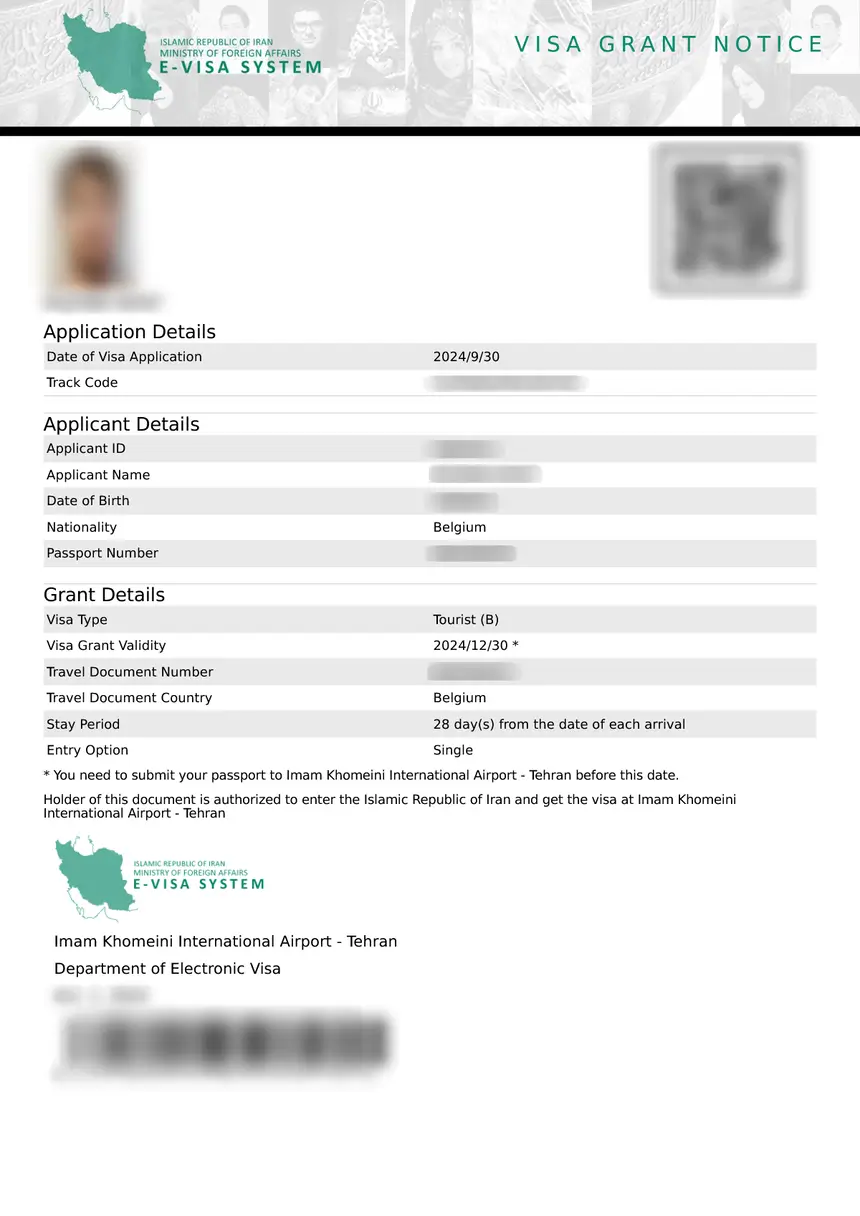
You apply by filling out an online form, uploading a passport photo, and submitting your itinerary. The MFA processes the application and emails a visa grant notice, which you print and carry with you. Processing typically takes 1 to 3 business days, though the system has a reputation for delays and occasional rejections without explanation. For more on timelines, see our guide to Iran visa processing time.
Key facts about the Iran eVisa:
- Apply at evisa.mfa.ir or through a licensed travel agency
- Processing time: 1 to 3 days (can take longer)
- You must apply at least 2 days before arrival, but 10+ days is safer
- After approval, you can collect the visa at an embassy, consulate, or airport
- The authorization code is valid for 60 days from issuance
- Visa validity after collection: 45 days to enter Iran
- Standard stay: 30 days (extendable up to 90 days)
What Is Iran Visa on Arrival?
The Iran visa on arrival (VOA) is a tourist visa issued directly at Iranian international airports. You do not need an authorization code or prior online application. You arrive, fill out a form at the visa counter, pay the fee, and receive your visa stamp. For a dedicated guide to the VOA process, airports, and eligibility, see our Iran visa on arrival page.
The VOA is available at all major Iranian airports including Tehran Imam Khomeini (IKA), Shiraz, Isfahan, Mashhad, Tabriz, and others. The process typically takes 30 to 90 minutes at the airport.
Key facts about the Iran VOA:
- Available at all Iranian international airports
- No prior application or authorization code required
- Standard duration: 30 days (some travelers report getting 60 days)
- Valid for a single entry only
- You can exit through any land or sea border
- Processing time at airport: 30 to 90 minutes
- Pay in Euros or US dollars (cash only)
Iran eVisa vs Visa on Arrival: Side-by-Side Comparison
| Feature | eVisa | Visa on Arrival (VOA) |
|---|---|---|
| Application | Online before travel | At airport upon landing |
| Prior approval needed | Yes (authorization code) | No |
| Processing time | 1 to 3 business days | 30 to 90 minutes at airport |
| Cost (visa fee) | Same as embassy rate, varies by nationality | Same as embassy rate, varies by nationality |
| Additional fees | None if applying directly; agency fee if using one | Health insurance at airport (approx. EUR 14 for 30 days) |
| Stay duration | 30 days standard | 30 days standard |
| Extendable | Yes, up to 90 days | Yes, up to 90 days |
| Entry points | Any border (airport, land, sea) | Airports only (entry); exit at any border |
| Countries excluded | Israeli passport holders | US, UK, Canada, Afghanistan, Bangladesh, Colombia, Iraq, Jordan, Pakistan, Somalia, Israel |
| Risk of rejection | Moderate (system issues, silent rejections) | Very low (almost never rejected at airport) |
| Best for | US/UK/Canada citizens, cautious travelers, those entering overland | Most nationalities flying into Iran |
Who Cannot Get a Visa on Arrival?
The VOA is not available to citizens of the following countries:
- United States
- United Kingdom
- Canada
- Afghanistan
- Bangladesh
- Colombia
- Iraq
- Jordan
- Pakistan
- Somalia
- Israel
If you hold one of these passports, your only options are the eVisa (which grants an authorization code you collect at an embassy) or a traditional embassy application. US, UK, and Canadian citizens typically need a guided tour itinerary and a reference number from an Iranian travel agency as part of their application. For detailed nationality-specific guidance, see our pages on Iran visa for US citizens and Iran visa for UK citizens.
Iran Visa Fees: What You Actually Pay
The visa fee itself is the same whether you choose the eVisa or the VOA. The fee depends on your nationality, not the method of application. For a complete breakdown by nationality, see our Iran visa fee guide.
| Nationality | Approximate Fee |
|---|---|
| EU countries (France, Germany, Italy, etc.) | EUR 75 |
| Australians | EUR 145 |
| Brazilians | EUR 80 |
| Indians | EUR 50 to 80 |
| Most other nationalities | EUR 40 to 100 |
If you choose the VOA at the airport, you must also purchase health insurance (approximately EUR 14 for 30 days) if you do not already have coverage that explicitly states Iran on the policy. International travel insurance plans often exclude Iran due to sanctions, so most travelers end up buying the airport insurance. Learn more in our Iran travel insurance guide.
If you use a travel agency for the eVisa, expect an additional service fee of around EUR 15 to 25. Agencies like 1stQuest charge approximately EUR 17 and claim a 98% approval rate, which is higher than applying directly through the MFA portal.
Which Should You Choose?
Choose the eVisa if:
- You are a US, UK, or Canadian citizen (VOA is not available to you)
- You want peace of mind before booking your flight
- You are entering Iran overland (VOA is airport-only for entry)
- You want to speed through the airport visa desk with a pre-approval letter
Choose Visa on Arrival if:
- You are from a country eligible for VOA (most nationalities except those listed above)
- You prefer the simplest process with no advance paperwork
- You are comfortable handling the visa process at the airport
- You want to avoid the sometimes-unreliable eVisa online system
For most travelers, the VOA is the easier and more reliable option. The eVisa system has a documented history of applications getting stuck, being rejected without explanation, and requiring multiple attempts. The VOA at the airport, by contrast, is a straightforward process that rarely results in rejection.
Practical Tips for Both Options
- Carry Euros in cash. US dollars are also accepted, but Euros are increasingly preferred due to sanctions-related payment difficulties
- Have your return or onward flight details ready (some airlines require proof of onward travel even if immigration does not)
- Print your eVisa grant notice if you applied online. A paper copy is essential
- Purchase travel insurance that explicitly covers Iran, or plan to buy it at the airport
- Your passport must be valid for at least 6 months and have at least 2 blank pages
- Remove or avoid Israeli passport stamps. Evidence of travel to Israel (including land entry stamps from Jordan at the Israel border) can result in denial
Visa-Free Islands: Kish and Qeshm
Two Iranian islands, Kish and Qeshm, offer a 14-day visa-free entry for travelers who are eligible for the VOA. This means if you are eligible for visa on arrival at an Iranian airport, you can also visit these islands without any visa at all. This is a lesser-known option for short trips or stopovers in the Persian Gulf.
Can You Extend an Iran VOA or eVisa?
Yes. Both the VOA and eVisa grant a standard 30-day stay, which can be extended at the immigration office in major Iranian cities. Extensions are typically granted in 15-day increments, up to a total of 90 days. The extension process usually takes one day and costs a small fee. For details on the extension process, see our Iran visa extension guide.
FAQs About Iran eVisa vs Visa on Arrival
Can I get an Iran eVisa on arrival?
Not exactly. The eVisa is a pre-approval you apply for online before arriving. However, you can collect the physical visa stamp at the airport using your eVisa grant notice. The VOA is a separate process that requires no prior application.
Is the Iran visa on arrival free?
No. The VOA has the same fee as an embassy or eVisa application. The fee depends on your nationality, typically ranging from EUR 40 to EUR 145. You must also purchase health insurance at the airport if you do not have qualifying coverage.
Which countries can get Iran visa on arrival?
Citizens of approximately 180 countries can get a VOA at Iranian airports. The major exceptions are US, UK, Canada, Afghanistan, Bangladesh, Colombia, Iraq, Jordan, Pakistan, Somalia, and Israel passport holders.
How long does the Iran visa on arrival take at the airport?
The VOA process at Iranian airports typically takes 30 to 90 minutes. This includes purchasing health insurance, submitting your application form, and paying the visa fee.
Is the Iran eVisa system reliable?
The eVisa system has had documented reliability issues. Applications sometimes get stuck in processing or are rejected without explanation. Many experienced travelers recommend using a licensed Iranian travel agency (such as 1stQuest) to handle the application, which has a higher approval rate.
Can US citizens get an Iran visa on arrival?
No. US, UK, and Canadian citizens cannot get a visa on arrival. They must apply for an eVisa or embassy visa, and typically need a guided tour itinerary and a reference number from an Iranian travel agency.
Do I need travel insurance for an Iran visa?
Yes. Travel insurance is mandatory for all Iran visa applicants. International insurance plans usually exclude Iran due to sanctions. You can purchase qualifying insurance at Iranian airports for approximately EUR 14 for 30 days, or buy it in advance through an Iranian travel agency.
Can I enter Iran overland with an eVisa?
Yes. The eVisa authorization code allows you to enter through any border: airport, land, or sea. The VOA, however, is only available at airports for entry. You can exit Iran through any border with either visa type.